Technical Specifications
| Specification | Details |
|---|---|
| Product | Steam Traps |
| Types | Float & Thermostatic, Inverted Bucket, Thermodynamic, Thermostatic |
| Size | DN / NPS, as required |
| Pressure Rating | Low, Medium & High Pressure, as per design |
| Body Materials | Carbon Steel, Stainless Steel, Alloy Steel, Cast Iron |
| Internal Materials | Stainless Steel, Alloy and Other Suitable Materials |
| End Connections | Threaded, Socket-Weld, Flanged, Butt-Weld |
| Applications | Steam Distribution, Boiler Systems, Heat Exchangers, Condensate Recovery |
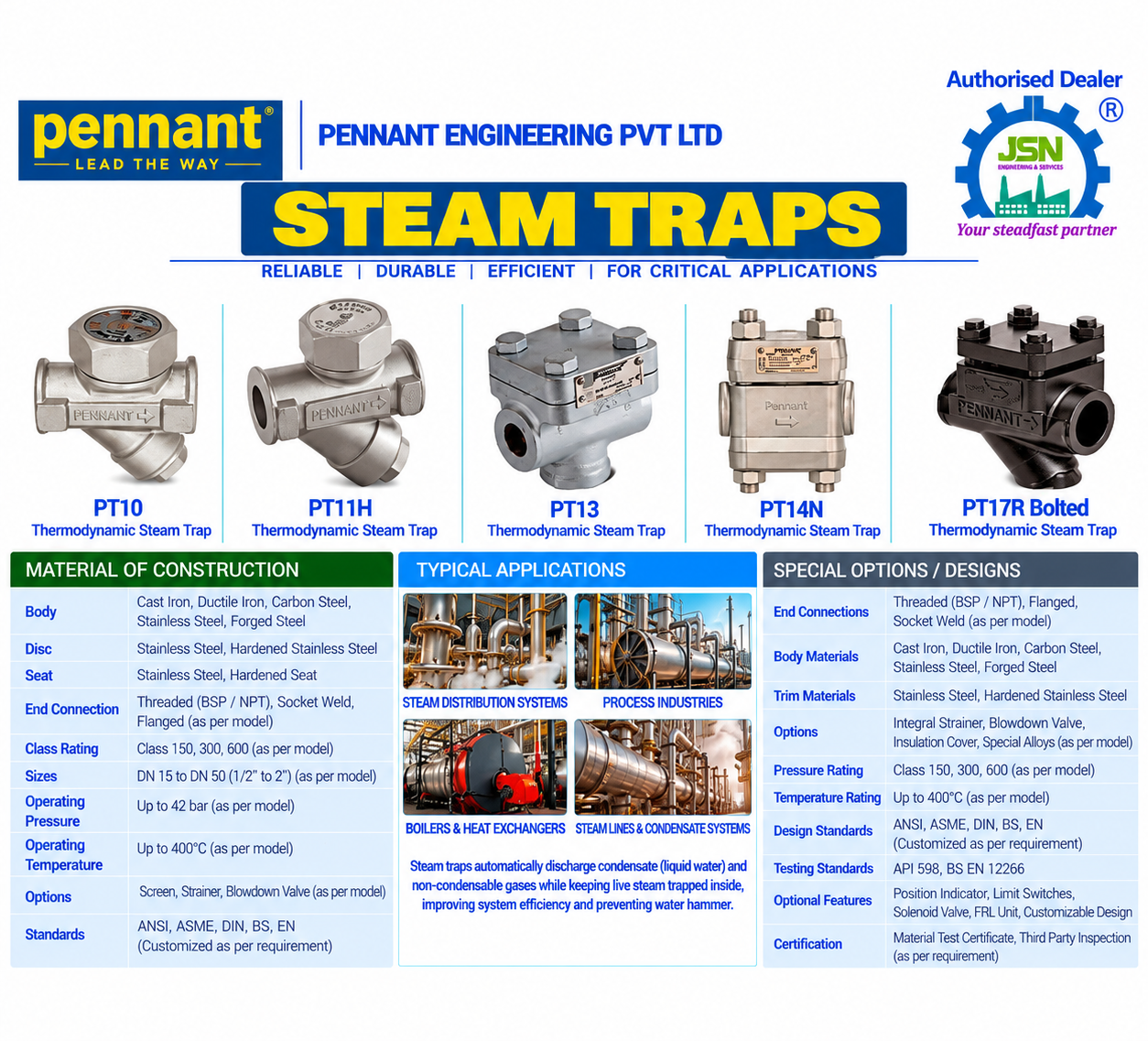
Product Information
Steam Traps — Technical Overview & Selection Guide
Overview
Steam traps are automatic self-actuated valves designed to remove condensate, air, and other non-condensable gases from steam systems while preventing the unnecessary loss of live steam. They operate automatically in response to differences in temperature, pressure, density, or phase conditions within the steam system.
Steam traps are essential components in steam distribution and condensate recovery systems, helping maintain efficient heat transfer, protect equipment from condensate accumulation, and reduce steam losses.
Key Features
-
Automatic removal of condensate from steam systems
-
Discharge of air and non-condensable gases, depending on trap design
-
Prevents unnecessary loss of live steam
-
Improves heat-transfer efficiency
-
Helps prevent water hammer and condensate accumulation
-
Suitable for saturated and superheated steam applications, according to design
-
Available for low-, medium-, and high-pressure steam systems
-
Compact and reliable designs available
-
Manual, thermodynamic, mechanical, and thermostatic operating principles
-
Suitable for horizontal and vertical installation, depending on design
-
Available in threaded, socket-weld, flanged, and butt-weld connections
-
Suitable for process heating, steam distribution, tracing, and condensate systems
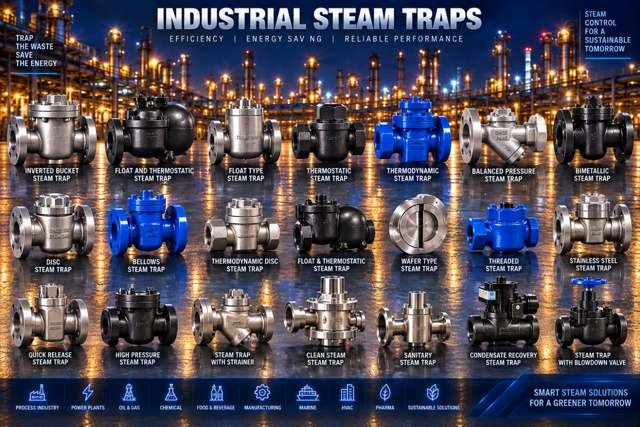
Common Steam Trap Types
-
Float & Thermostatic Steam Trap
-
Inverted Bucket Steam Trap
-
Thermodynamic Disc Steam Trap
-
Thermostatic Steam Trap
-
Balanced Pressure Thermostatic Trap
-
Bimetallic Steam Trap
-
Free Float Steam Trap
-
Fixed Orifice Steam Trap
-
Pump-Trap Combination, where applicable
Technical Selection Parameters
Selection should consider:
| Parameter | Selection Consideration |
|---|---|
| Trap Type | Float & Thermostatic / Inverted Bucket / Thermodynamic / Thermostatic |
| Size | DN / NPS |
| Pressure Rating | As applicable to trap design |
| Design Pressure | Project/design requirement |
| Design Temperature | Project/design requirement |
| Steam Type | Saturated / Superheated |
| Inlet Pressure | Operating steam pressure |
| Outlet Pressure | Back pressure / return-system pressure |
| Differential Pressure | Pressure difference across trap |
| Condensate Load | Minimum / Normal / Maximum |
| Start-Up Load | Initial air and condensate load |
| Body Material | Carbon Steel / Stainless Steel / Alloy Steel / Cast Iron |
| Internal Material | Stainless Steel / Alloy / Other suitable materials |
| Seat & Disc | Selected according to pressure and service |
| Air Venting | Required air and non-condensable gas removal |
| End Connection | Threaded / Socket-Weld / Flanged / Butt-Weld |
| Installation | Horizontal / Vertical, according to design |
| Back Pressure | Condensate return system pressure |
| Freeze Protection | Required for outdoor or low-temperature service |
| Drainage Requirement | Equipment and piping drainage requirements |
| Steam Loss | Required energy-efficiency performance |
Materials
Common steam trap body materials include:
-
Carbon Steel
-
Stainless Steel
-
Alloy Steel
-
Cast Iron
-
Ductile Iron, where applicable
Internal components such as floats, buckets, discs, valves, seats, springs, and thermostatic elements should be selected based on pressure, temperature, steam quality, corrosion, erosion, and condensate characteristics.
Steam Trap Selection
The appropriate steam trap type should be selected according to the application and operating conditions.
Float & Thermostatic Traps: Suitable where continuous condensate discharge and good air removal are required.
Inverted Bucket Traps: Suitable for applications requiring robust mechanical operation and intermittent condensate discharge.
Thermodynamic Disc Traps: Compact and suitable for a wide range of steam pressures, particularly where simple and rugged construction is required.
Thermostatic Traps: Suitable where condensate discharge is controlled according to temperature and where air and non-condensable gas removal is important.
End Connections
Steam traps may be supplied with:
-
Threaded Ends
-
Socket-Weld Ends
-
Flanged Ends
-
Butt-Weld Ends
-
Union Connections, where applicable
The end connection should match the piping system, pressure rating, installation arrangement, and applicable project specifications.
Installation & Operation
Steam traps may be installed using:
-
Horizontal Installation
-
Vertical Installation
-
Upward or Downward Flow Arrangements, where permitted by design
Installation orientation is critical and should follow the manufacturer’s recommendations for the selected trap type.
Steam traps operate automatically without external actuation. Proper installation, sizing, and condensate drainage arrangement are essential for reliable performance.
Quick Selection Guide
Steam Type: Identify whether the service is saturated or superheated steam.
Steam Pressure: Provide minimum, normal, and maximum inlet steam pressure.
Temperature: Specify operating and design temperature.
Condensate Load: Provide minimum, normal, and maximum condensate flow requirements.
Start-Up Load: Consider the additional condensate and air load during equipment start-up.
Differential Pressure: Provide inlet pressure and condensate return/back pressure to determine the available differential pressure.
Back Pressure: Confirm the pressure in the condensate return system.
Trap Type: Select float & thermostatic, inverted bucket, thermodynamic, thermostatic, or another suitable design according to the application.
Air Removal: Evaluate the requirement for automatic removal of air and non-condensable gases.
Steam Loss: Select a suitable trap design and capacity to minimize live-steam loss.
Installation: Confirm required installation orientation and ensure correct drainage of condensate from the equipment or piping.
Freeze Protection: For outdoor or low-temperature installations, consider freezing conditions and appropriate drainage arrangements.
Connection: Specify threaded, socket-weld, flanged, or butt-weld connection as applicable.
Condensate Return: Confirm condensate recovery arrangement, return pressure, and discharge conditions.
Testing & Inspection
Depending on project specifications and applicable standards, steam traps may undergo:
-
Shell/body pressure testing
-
Seat leakage testing
-
Operational testing
-
Condensate discharge verification
-
Steam-loss/performance testing, where specified
-
Dimensional inspection
-
Internal component inspection
-
PMI (Positive Material Identification), where applicable
-
MTC verification
-
Visual and surface inspection
-
NDE (Non-Destructive Examination), where applicable
Applications
Steam traps are commonly used in:
-
Oil & Gas
-
Refineries
-
Petrochemical Plants
-
Chemical Plants
-
Power Plants
-
Steam Distribution Systems
-
Boiler Systems
-
Heat Exchangers
-
Process Heaters
-
Reboilers
-
Steam Tracing Systems
-
Jacketed Vessels
-
Dryers
-
Heat Transfer Equipment
-
Condensate Recovery Systems
-
Food & Process Industries
-
Pharmaceutical Industries
-
Utilities
-
Industrial Plants
Engineering Inputs for RFQ
For technical enquiry and quotation, provide:
Steam Trap Type • Size • Pressure Rating • Steam Type • Inlet Pressure • Outlet/Back Pressure • Differential Pressure • Design Pressure • Operating & Design Temperature • Minimum/Normal/Maximum Condensate Load • Start-Up Load • Body Material • Internal Material • Seat & Disc Material • End Connection • Installation Orientation • Air Venting Requirement • Freeze Protection Requirement • Condensate Return Arrangement • Steam Loss Requirement • Testing & Inspection Requirements
Manufacturer Brands
1. ZOLOTO — Industrial Valves
Brand: ZOLOTO
Website: www.zolotovalves.com
2. MARCK — Industrial Valves
Brand: MARCK
Manufacturer: Hawa Engineers Ltd.
Website: www.marckvalves.com
3. LEHRY — Industrial Valves and Instrumentation
Brand: LEHRY
Manufacturer: Lehry Instrumentation & Valves Pvt. Ltd.
Website: www.lehryvalves.com
4. UFLOW — Automation and Process Control Valves
Brand: UFLOW
Manufacturer: Uflow Automation India
Website: www.uflowvalve.com
5. V-TORK CONTROLS — Industrial Flow Control Valves
Brand: V-TORK CONTROLS
Website: www.vtorkcontrols.com
6. PENNANT — Steam Traps and Pipeline Accessories
Brand: PENNANT
Manufacturer: Pennant Engineering Pvt. Ltd.
Website: www.pennantcorp.com