Technical Specifications
| Specification | Details |
|---|---|
| Product | Piston Valves |
| Valve Types | Single Piston, Double Piston, Balanced, Unbalanced, Straight-Pattern, Angle-Pattern, Forged, Cast |
| Valve Design | Linear Motion, Cylindrical Piston with Sealing Rings |
| Size | DN / NPS, as required |
| Pressure Class | ASME Class 150–2500, as applicable |
| Body Materials | Carbon Steel, Stainless Steel, Alloy Steel, Cast Iron, Forged Steel |
| Piston Materials | Stainless Steel, Alloy Steel, Hardened Stainless Steel, Wear-Resistant Alloys |
| Sealing Materials | Graphite, PTFE, Carbon-Based, Metal, Composite Materials |
| Stem Material | Selected according to pressure, temperature and service |
| Seat Arrangement | Single / Double Sealing Ring |
| End Connections | Flanged, Butt-Weld, Threaded, Socket-Weld |
| Operation | Handwheel, Gear, Pneumatic, Electric, Hydraulic |
| Flow Direction | As required by valve design |
| Installation | Horizontal / Vertical, according to design |
| Applications | Steam, Gas, Liquid and Industrial Process Services |
Product Information
Piston Valves — Technical Overview & Selection Guide
Overview
Piston valves are linear-motion valves designed for reliable isolation and flow control in piping and process systems. They use a cylindrical piston that moves within one or more sealing rings to open, restrict, or shut off the flow passage.
The piston and sealing-ring arrangement provides effective sealing and helps minimize direct contact between the moving piston and the valve body. Piston valves are commonly used in applications requiring reliable shut-off, frequent operation, and resistance to wear under demanding service conditions.
Key Features
-
Reliable isolation and shut-off
-
Effective sealing through piston and sealing-ring arrangement
-
Suitable for steam, gas, liquid, and process services
-
Suitable for high-pressure and high-temperature applications
-
Good resistance to thermal shock and pressure fluctuations
-
Suitable for frequent opening and closing operations
-
Reduced risk of seat damage in suitable applications
-
Available in straight and angle-pattern configurations
-
Low leakage performance when properly selected and maintained
-
Manual and automated operation options available
-
Flanged, butt-weld, and threaded connections available, depending on design
-
Available in various body, piston, and sealing materials
-
Suitable for horizontal and vertical installation, depending on design
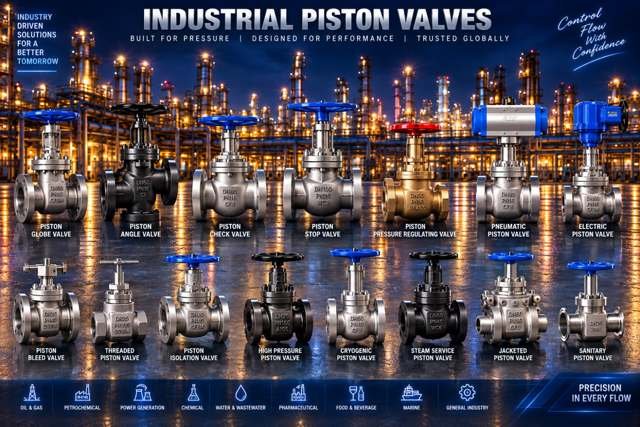
Common Piston Valve Types
-
Single Piston Valve
-
Double Piston Valve
-
Balanced Piston Valve
-
Unbalanced Piston Valve
-
Straight-Pattern Piston Valve
-
Angle-Pattern Piston Valve
-
Forged Piston Valve
-
Cast Piston Valve
-
Manual Piston Valve
-
Actuated Piston Valve
Technical Selection Parameters
Selection should consider:
| Parameter | Selection Consideration |
|---|---|
| Valve Type | Single / Double / Balanced / Unbalanced |
| Size | DN / NPS |
| Pressure Class | ASME Class 150–2500, as applicable |
| Design Pressure | Project/design requirement |
| Design Temperature | Project/design requirement |
| Fluid | Liquid / Gas / Steam / Process Fluid |
| Flow Rate | Minimum / Normal / Maximum Flow |
| Flow Direction | Required flow direction |
| Body Material | Carbon Steel / Stainless Steel / Alloy Steel / Cast Iron |
| Piston Material | Stainless Steel / Alloy Steel / Hardened Material |
| Sealing Rings | Graphite / PTFE / Metal / Other suitable materials |
| Stem Material | Selected according to pressure, temperature, and service |
| Seat Arrangement | Single / Double Sealing Ring |
| Pressure Drop | Required flow capacity and system requirements |
| Shut-Off Requirement | Required isolation and leakage performance |
| End Connection | Flanged / Butt-Weld / Threaded, as applicable |
| Operation | Manual / Gear Operated / Pneumatic / Electric |
| Installation | Horizontal / Vertical, according to design |
| Operating Frequency | Required cycle frequency |
| Emission Requirement | Packing/sealing requirements, where applicable |
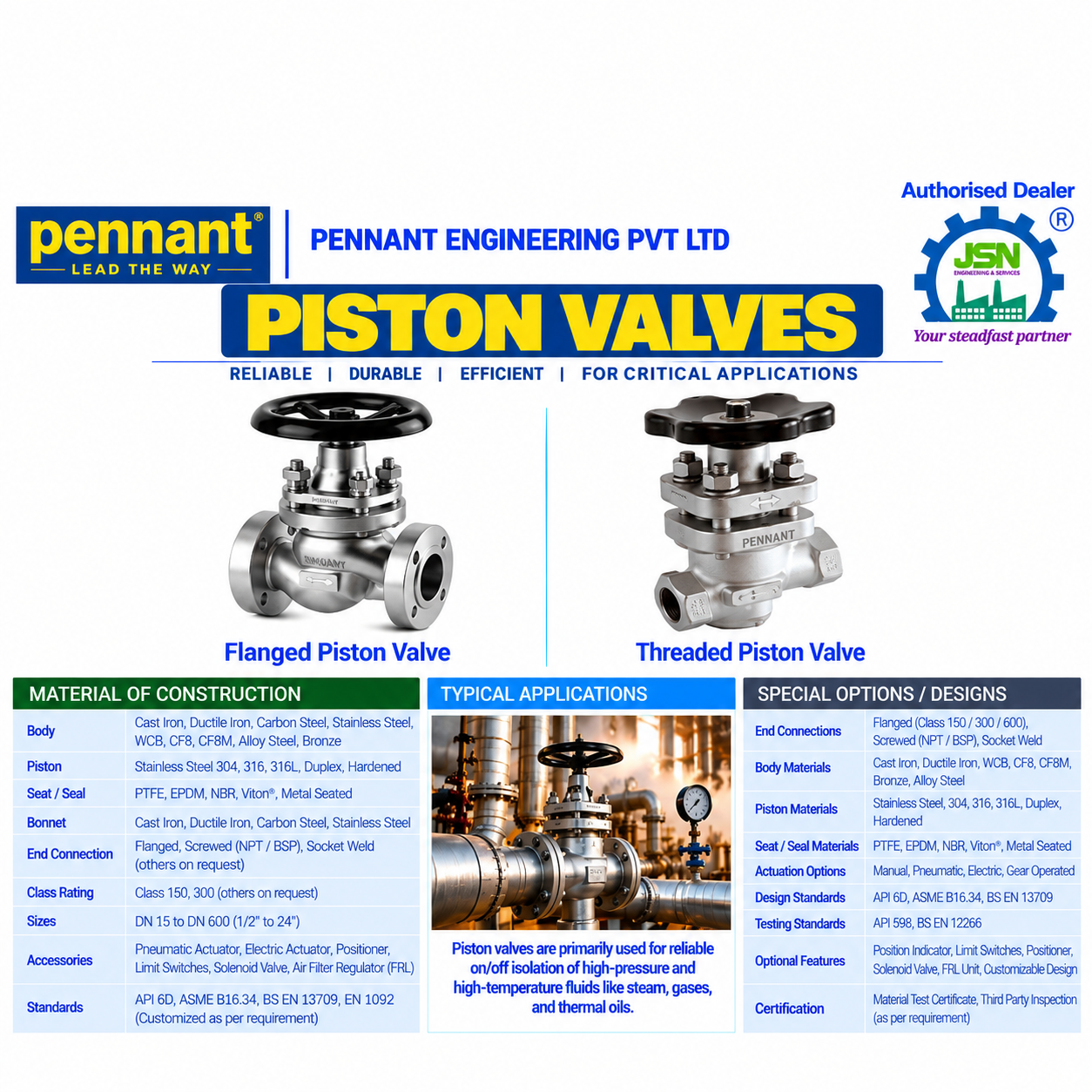
Materials
Common piston valve body materials include:
-
Carbon Steel
-
Stainless Steel
-
Alloy Steel
-
Cast Iron, where applicable
-
Forged Steel, where applicable
Piston, stem, sealing rings, and other wetted or process-contact materials should be selected according to fluid compatibility, pressure, temperature, erosion, corrosion, and service requirements.
Common piston materials may include:
-
Stainless Steel
-
Alloy Steel
-
Hardened Stainless Steel
-
Special Wear-Resistant Alloys, where applicable
Piston & Sealing Ring Selection
The piston and sealing-ring arrangement is a critical selection parameter for achieving reliable shut-off and long service life.
Selection may consider:
-
Pressure Resistance
-
Temperature Resistance
-
Wear Resistance
-
Corrosion Resistance
-
Fluid Compatibility
-
Thermal Cycling
-
Pressure Fluctuations
-
Operating Frequency
-
Required Leakage Performance
-
Required Service Life
Common sealing materials may include:
-
Graphite
-
PTFE
-
Carbon-Based Materials
-
Metal Sealing Rings
-
Specialized Composite Materials
For steam and high-temperature applications, suitable graphite or metal-based sealing arrangements may be selected according to the design and service conditions.
Packing & Sealing
Piston valves may incorporate stem packing and sealing arrangements selected according to process conditions.
Selection may consider:
-
Process Fluid
-
Operating Temperature
-
Operating Pressure
-
Corrosiveness
-
Emission Requirements
-
Operating Frequency
-
Required Leakage Performance
Graphite-based packing and other specialized sealing materials may be used for high-temperature and demanding services, subject to valve design.
End Connections
Piston valves may be supplied with:
-
Flanged Ends
-
Butt-Weld Ends
-
Threaded Ends, where applicable
-
Socket-Weld Ends, where applicable
The end connection should match the piping system, pressure rating, installation arrangement, and applicable project specifications.
Operation
Piston valves may be operated using:
-
Handwheel
-
Gear Operator
-
Pneumatic Actuator
-
Electric Actuator
-
Hydraulic Actuator, where applicable
Manual operation is commonly used for smaller or less frequently operated valves, while automated operation may be selected where remote operation or frequent cycling is required.
Quick Selection Guide
Fluid: Identify whether the service is liquid, gas, steam, or another process medium.
Flow Rate: Provide minimum, normal, and maximum flow requirements.
Size: Specify DN/NPS based on piping size and required flow capacity.
Pressure: Provide operating and design pressure together with the applicable pressure class.
Temperature: Specify minimum, normal, maximum operating temperature, and design temperature.
Valve Type: Select single-piston, double-piston, balanced, unbalanced, straight-pattern, or angle-pattern configuration according to the application.
Piston Material: Select piston material based on pressure, temperature, corrosion, erosion, and fluid characteristics.
Sealing Rings: Select sealing-ring material and configuration according to fluid, temperature, pressure, thermal cycling, and leakage requirements.
Pressure Drop: Evaluate the required flow capacity and allowable system pressure loss.
Shut-Off: Define the required isolation and leakage performance.
Operation: Specify manual, gear-operated, pneumatic, electric, or hydraulic operation.
Installation: Confirm horizontal or vertical installation requirements according to the selected valve design.
Operating Frequency: Provide expected cycle frequency where the valve will be frequently operated.
Emission Requirements: Specify packing and sealing requirements where fugitive-emission control is required.
Connection: Specify flanged, butt-weld, threaded, or socket-weld connection as applicable.
Testing & Inspection
Depending on project specifications and applicable standards, piston valves may undergo:
-
Shell/body pressure testing
-
Seat leakage testing
-
Functional and operational testing
-
Piston travel verification
-
Stem operation testing
-
Dimensional inspection
-
Sealing-ring inspection
-
PMI (Positive Material Identification), where applicable
-
MTC verification
-
Visual and surface inspection
-
Actuator and accessory testing
-
NDE (Non-Destructive Examination), where applicable
Applications
Piston valves are commonly used in:
-
Oil & Gas
-
Refineries
-
Petrochemical Plants
-
Chemical Plants
-
Power Plants
-
Steam Systems
-
Boiler Systems
-
Process Piping
-
Heating Systems
-
Condensate Systems
-
Water Treatment
-
Pumping Systems
-
High-Pressure Process Lines
-
Utilities
-
Industrial Plants
Engineering Inputs for RFQ
For technical enquiry and quotation, provide:
Valve Type • Size • Pressure Class • Fluid • Flow Direction • Minimum/Normal/Maximum Flow • Design Pressure • Operating & Design Temperature • Body Material • Piston Material • Sealing Ring Material • Stem Material • Packing • End Connection • Operation/Actuation • Installation Orientation • Operating Frequency • Emission Requirements • Shut-Off Requirement • Testing & Inspection Requirements
Manufacturer Brands
1. ZOLOTO — Industrial Valves
Brand: ZOLOTO
Website: www.zolotovalves.com
2. MARCK — Industrial Valves
Brand: MARCK
Manufacturer: Hawa Engineers Ltd.
Website: www.marckvalves.com
3. LEHRY — Industrial Valves and Instrumentation
Brand: LEHRY
Manufacturer: Lehry Instrumentation & Valves Pvt. Ltd.
Website: www.lehryvalves.com
4. UFLOW — Automation and Process Control Valves
Brand: UFLOW
Manufacturer: Uflow Automation India
Website: www.uflowvalve.com
5. V-TORK CONTROLS — Industrial Flow Control Valves
Brand: V-TORK CONTROLS
Website: www.vtorkcontrols.com
6. PENNANT — Steam Traps and Pipeline Accessories
Brand: PENNANT
Manufacturer: Pennant Engineering Pvt. Ltd.
Website: www.pennantcorp.com