Technical Specifications
| Specification | Details |
|---|---|
| Product | Industrial Control Valves |
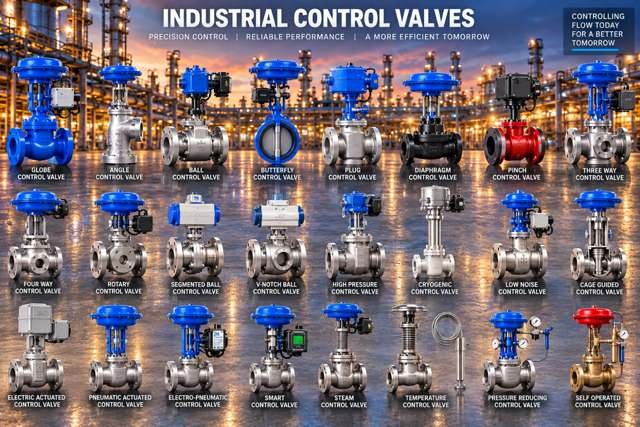
| Types | Globe, Angle, Cage-Guided, Top-Guided, Rotary, Butterfly, Ball, V-Ball, Eccentric Plug & Three-Way |
| Design | Linear Motion & Rotary Control |
| Pressure Class | ASME Class 150–2500, as applicable |
| Body Materials | Carbon Steel, Stainless Steel, Alloy Steel, Cast Iron & Forged Steel |
| Trim & Seat | Stainless Steel, Alloy, Hardened Trim, Anti-Cavitation, Low-Noise, Metal & Soft Seats |
| Flow Characteristics | Linear, Equal Percentage & Quick Opening |
| Flow Capacity | Selected as per Required Cv / Kv |
| Actuation | Pneumatic, Electric, Hydraulic & Electro-Hydraulic |
| Fail Action | Fail Open, Fail Closed & Fail in Place |
| Positioner | Conventional, Smart & Electro-Pneumatic |
| End Connections | Flanged, Butt-Weld & Threaded |
| Applications | Oil & Gas, Chemical, Power, Petrochemical, Steam, Water Treatment & Process Industries |
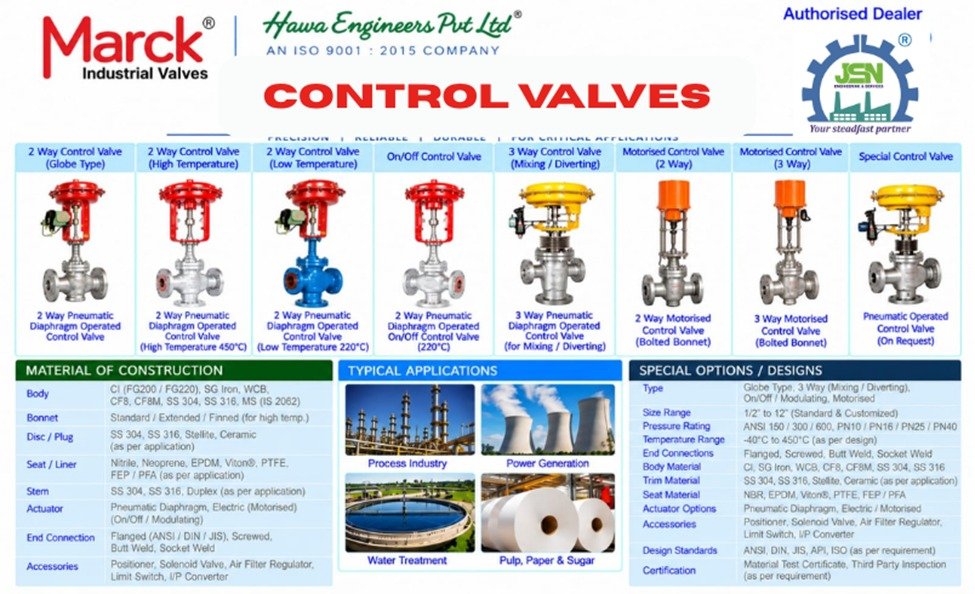
Product Information
Control Valves — Technical Overview & Selection Guide
Overview
Control valves are automatic final control elements used to regulate the flow, pressure, temperature, level, and other process variables within a piping or process system. They operate by varying the valve opening in response to a control signal from a process control system.
Control valves are selected and sized according to process conditions, flow requirements, pressure drop, fluid characteristics, operating temperature, and required control performance.
Key Features
-
Automatic regulation of process flow and operating conditions
-
Suitable for flow, pressure, temperature, and level control
-
Precise and repeatable flow control
-
Suitable for liquid, gas, steam, and multiphase services, subject to design
-
Available in linear and rotary control valve configurations
-
Wide range of flow characteristics available
-
Pneumatic, electric, and hydraulic actuation options
-
Available with positioners and control accessories
-
Suitable for high-pressure and high-temperature applications
-
Available in various body, trim, and seat materials
-
Available in ASME Class 150–2500, as applicable
Common Control Valve Types
-
Globe Control Valve
-
Angle Control Valve
-
Cage-Guided Control Valve
-
Top-Guided Control Valve
-
Rotary Control Valve
-
Butterfly Control Valve
-
Ball Control Valve
-
V-Ball Control Valve
-
Eccentric Plug Control Valve
-
Three-Way Control Valve
-
Split-Body Control Valve
Technical Selection Parameters
Selection should consider:
| Parameter | Selection Consideration |
|---|---|
| Valve Type | Globe / Angle / Ball / Butterfly / Rotary / Three-Way |
| Size | DN / NPS |
| Pressure Class | ASME Class 150–2500, as applicable |
| Design Pressure | Project/design requirement |
| Design Temperature | Project/design requirement |
| Fluid | Liquid / Gas / Steam / Multiphase |
| Flow Rate | Minimum / Normal / Maximum Flow |
| Inlet Pressure | Upstream operating pressure |
| Outlet Pressure | Downstream operating pressure |
| Differential Pressure | Pressure drop across valve |
| Flow Characteristic | Linear / Equal Percentage / Quick Opening |
| Body Material | Carbon Steel / Stainless Steel / Alloy Steel |
| Trim Material | Selected according to service conditions |
| Seat Type | Metal Seat / Soft Seat, as applicable |
| Cv / Kv | Required flow coefficient |
| Shut-Off Requirement | Required leakage class |
| Actuator | Pneumatic / Electric / Hydraulic |
| Fail Action | Fail Open / Fail Closed / Fail in Place |
| Positioner | Conventional / Smart Positioner |
| End Connection | Flanged / Butt-Weld / Threaded, as applicable |
| Installation | Horizontal / Vertical, according to design |
| Noise & Cavitation | Evaluation required for critical services |
Materials
Common control valve body materials include:
-
Carbon Steel
-
Stainless Steel
-
Alloy Steel
-
Cast Iron, where applicable
-
Forged Steel, where applicable
Trim, plug, cage, stem, shaft, and seat materials should be selected based on fluid compatibility, pressure, temperature, erosion, corrosion, velocity, cavitation, flashing, and service requirements.
Trim & Seat
Typical trim and seat configurations may include:
-
Stainless Steel Trim
-
Alloy Trim
-
Hardened Trim
-
Anti-Cavitation Trim
-
Low-Noise Trim
-
Metal-to-Metal Seats
-
Soft Seats
-
Stellite® or equivalent hard-facing, where specified
Trim selection is particularly important for high-pressure-drop, erosive, corrosive, flashing, cavitating, or high-velocity services.
Flow Characteristics
Control valves may be provided with different inherent flow characteristics, including:
-
Linear — Flow capacity changes approximately proportionally with valve travel.
-
Equal Percentage — Each increment of valve travel produces a proportional change in flow coefficient.
-
Quick Opening — Provides rapid flow increase at low valve travel and is generally used where fast opening is required.
The appropriate characteristic should be selected according to the process dynamics and control-loop requirements.
Actuation
Control valves may be operated using:
-
Pneumatic Actuator
-
Electric Actuator
-
Hydraulic Actuator
-
Electro-Hydraulic Actuator, where applicable
Pneumatic actuators are commonly used for industrial process control applications due to their fast response and suitability for automated systems.
Fail-Safe Action
Depending on process safety requirements, control valves may be configured for:
-
Fail Open (FO)
-
Fail Closed (FC)
-
Fail in Place (FIP)
Fail action should be selected based on the safe condition required by the process and control philosophy.
Positioners & Accessories
Control valves may be supplied with:
-
Smart Valve Positioner
-
Electro-Pneumatic Positioner
-
I/P Converter
-
Solenoid Valve
-
Limit Switches
-
Position Transmitter
-
Air Filter Regulator
-
Volume Booster
-
Lock-Up Valve
-
Quick Exhaust Valve
-
Manual Override, where applicable
Control Valve Sizing
Control valve sizing should be based on the required Cv/Kv, flow rate, pressure drop, fluid properties, and operating conditions.
Important sizing inputs include:
-
Minimum Flow
-
Normal Flow
-
Maximum Flow
-
Upstream Pressure
-
Downstream Pressure
-
Differential Pressure
-
Operating Temperature
-
Fluid Density / Specific Gravity
-
Viscosity
-
Molecular Weight for gases
-
Vapor Pressure for liquids
-
Critical Pressure, where applicable
-
Compressibility, where applicable
The valve should be sized to provide stable and controllable operation across the required operating range while avoiding excessive velocity, cavitation, flashing, choking, or unacceptable noise.
Quick Selection Guide
Process Variable: Identify whether the valve will control flow, pressure, temperature, level, or another process variable.
Fluid: Specify liquid, gas, steam, or multiphase service together with relevant fluid properties.
Flow Rate: Provide minimum, normal, and maximum flow conditions.
Pressure: Provide inlet pressure, outlet pressure, and differential pressure for the operating cases.
Temperature: Specify minimum, normal, and maximum operating temperatures and design temperature.
Valve Type: Select globe, angle, ball, butterfly, V-ball, eccentric plug, or another suitable configuration based on service and control requirements.
Cv/Kv: Determine the required flow coefficient based on the applicable process conditions.
Flow Characteristic: Select linear, equal percentage, quick opening, or another characteristic according to the control-loop requirements.
Pressure Drop: Evaluate pressure loss and ensure the selected valve provides adequate control authority.
Cavitation & Flashing: For liquid services, evaluate vapor pressure and pressure recovery to identify potential cavitation or flashing conditions.
Noise: Evaluate aerodynamic or hydrodynamic noise for high-pressure-drop and high-velocity applications.
Actuation: Specify pneumatic, electric, hydraulic, or other actuator requirements.
Fail Action: Define Fail Open, Fail Closed, or Fail in Place based on process safety requirements.
Positioner: Specify conventional or smart positioner and required communication protocol, where applicable.
Shut-Off: Define the required seat leakage class and isolation requirements.
Connection: Specify flanged, butt-weld, threaded, or other applicable end connection.
Testing & Inspection
Depending on project specifications and applicable standards, control valves may undergo:
-
Shell/body pressure testing
-
Seat leakage testing
-
Functional and operational testing
-
Control valve performance testing
-
Stroking and travel verification
-
Positioner calibration
-
Fail-action verification
-
Dimensional inspection
-
PMI (Positive Material Identification)
-
MTC verification
-
NDE (Non-Destructive Examination)
-
Material and coating inspection, where applicable
Applications
Control valves are commonly used in:
-
Oil & Gas
-
Refineries
-
Petrochemical Plants
-
Chemical Plants
-
Power Plants
-
Steam Systems
-
Boiler & Feedwater Systems
-
Process Piping
-
Water Treatment
-
Pressure Control Systems
-
Flow Control Systems
-
Temperature Control Systems
-
Level Control Systems
-
Gas Processing
-
Utilities
-
Industrial Plants
Engineering Inputs for RFQ
For technical enquiry and quotation, provide:
Control Valve Type • Size • Pressure Class • Fluid • Flow Direction • Minimum/Normal/Maximum Flow • Inlet Pressure • Outlet Pressure • Differential Pressure • Design Pressure • Operating & Design Temperature • Fluid Properties • Body Material • Trim Material • Seat Type • Required Cv/Kv • Flow Characteristic • End Connection • Actuator Type • Fail Action • Positioner • Accessories • Installation Orientation • Noise/Cavitation Requirements • Shut-Off/Leakage Class • Testing & Inspection Requirements
Manufacturer Brands
1. ZOLOTO — Industrial Valves
Brand: ZOLOTO
Website: www.zolotovalves.com
2. MARCK — Industrial Valves
Brand: MARCK
Manufacturer: Hawa Engineers Ltd.
Website: www.marckvalves.com
3. LEHRY — Industrial Valves and Instrumentation
Brand: LEHRY
Manufacturer: Lehry Instrumentation & Valves Pvt. Ltd.
Website: www.lehryvalves.com
4. UFLOW — Automation and Process Control Valves
Brand: UFLOW
Manufacturer: Uflow Automation India
Website: www.uflowvalve.com
5. V-TORK CONTROLS — Industrial Flow Control Valves
Brand: V-TORK CONTROLS
Website: www.vtorkcontrols.com
6. PENNANT — Steam Traps and Pipeline Accessories
Brand: PENNANT
Manufacturer: Pennant Engineering Pvt. Ltd.
Website: www.pennantcorp.com