Technical Specifications
| Specification | Details |
|---|---|
| Product | Industrial Gate Valves |
| Types | Wedge, Solid Wedge, Flexible Wedge, Split Wedge, Parallel Slide, Slab & Expanding Gate |
| Design | Rising Stem, Non-Rising Stem, OS&Y & Inside Screw |
| Pressure Class | ASME Class 150–2500, as applicable |
| Body Materials | Carbon Steel, Stainless Steel, Alloy Steel, Cast Iron & Ductile Iron |
| Gate / Wedge Materials | Selected as per service conditions |
| Trim & Seat | Stainless Steel, Alloy, Hardened Trim, Metal-to-Metal & Resilient Seats |
| End Connections | Flanged, Butt-Weld, Threaded & Socket-Weld |
| Operation | Handwheel, Gear, Pneumatic, Electric & Hydraulic |
| Applications | Oil & Gas, Refineries, Chemical, Power, Water Treatment & Process Industries |
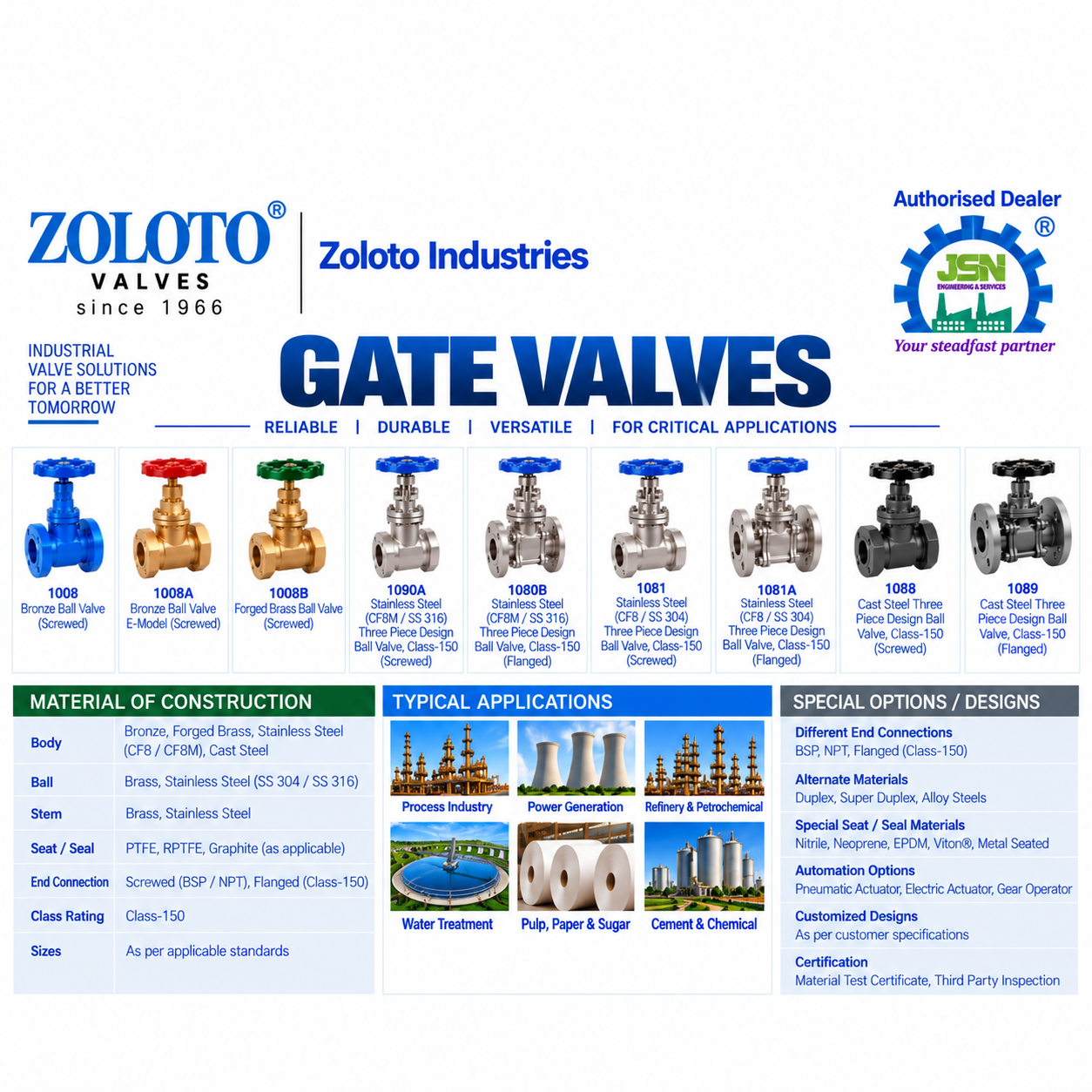
Product Information
Gate Valves — Technical Overview & Selection Guide
Overview
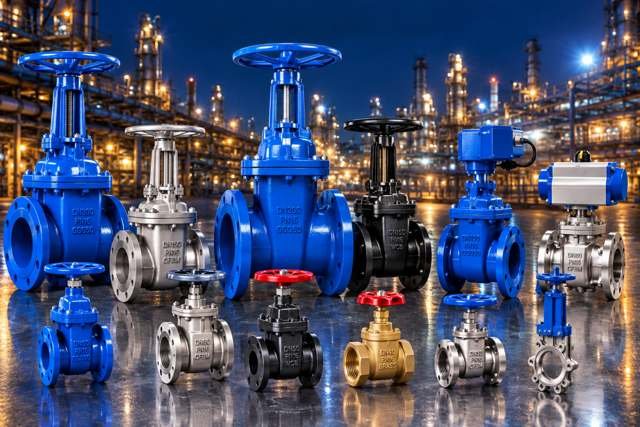
Gate valves are linear-motion isolation valves designed to provide reliable on/off flow control in piping systems. They operate by raising or lowering a gate or wedge through the fluid passage. Gate valves are primarily used for fully open or fully closed service and are generally not recommended for throttling applications.
Key Features
-
Reliable isolation and shut-off
-
Full-bore flow passage with low pressure drop when fully open
-
Suitable for liquid, gas, steam, and process services
-
Suitable for high-pressure and high-temperature applications
-
Available in rising stem and non-rising stem designs
-
Outside Screw and Yoke (OS&Y) and inside screw configurations available
-
Flanged and butt-weld end connections
-
Available with wedge, parallel slide, or slab gate designs
-
Suitable for a wide range of industrial and process applications
-
Available in ASME Class 150–2500, as applicable
Common Gate Valve Types
-
Wedge Gate Valve
-
Solid Wedge Gate Valve
-
Flexible Wedge Gate Valve
-
Split Wedge Gate Valve
-
Parallel Slide Gate Valve
-
Slab Gate Valve
-
Expanding Gate Valve
-
Rising Stem Gate Valve
-
Non-Rising Stem Gate Valve
Technical Selection Parameters
Selection should consider:
| Parameter | Selection Consideration |
|---|---|
| Size | DN / NPS |
| Pressure Class | ASME Class 150–2500, as applicable |
| Design Pressure | Project/design requirement |
| Design Temperature | Project/design requirement |
| Fluid | Liquid / Gas / Steam / Process Fluid |
| Flow Direction | Required flow direction, where applicable |
| Valve Type | Wedge / Parallel Slide / Slab / Expanding |
| Body Material | Carbon Steel / Stainless Steel / Alloy Steel / Cast Iron |
| Gate/Wedge Material | Based on service conditions |
| Trim & Seat | Based on fluid compatibility and operating conditions |
| Stem Material | Selected according to pressure, temperature, and service |
| End Connection | Flanged / Butt-Weld / Threaded, as applicable |
| Operation | Manual / Gear Operated / Actuated |
| Installation | Horizontal / Vertical, according to valve design |
| Face-to-Face | As per applicable standard |
| Pressure Drop | Generally low when fully open |
| Shut-Off Requirement | Isolation and leakage-class requirements |
Materials
Common body materials include:
-
Carbon Steel
-
Stainless Steel
-
Alloy Steel
-
Cast Iron
-
Ductile Iron, where applicable
Gate, stem, trim, and seat materials should be selected based on fluid compatibility, pressure, temperature, erosion, corrosion, and service requirements.
Trim & Seat
Trim and seat configurations may include:
-
Stainless Steel Trim
-
Alloy Trim
-
Hardened Trim
-
Metal-to-Metal Seats
-
Resilient Seats, where applicable
-
Stellite® or equivalent hard-facing, where specified
Material selection depends on process fluid, operating temperature, pressure, corrosion resistance, erosion resistance, and required service life.
End Connections
-
Flanged
-
Butt-Weld
-
Threaded, where applicable
-
Socket-Weld, where applicable
Operation
Gate valves may be operated using:
-
Handwheel
-
Gear Operator
-
Pneumatic Actuator
-
Electric Actuator
-
Hydraulic Actuator, where applicable
The operating arrangement should be selected based on valve size, pressure, accessibility, operating frequency, and automation requirements.
Testing & Inspection
Depending on project specifications and applicable standards, gate valves may undergo:
-
Shell/body pressure testing
-
Seat leakage testing
-
Backseat testing, where applicable
-
Dimensional inspection
-
PMI (Positive Material Identification)
-
MTC verification
-
NDE (Non-Destructive Examination)
-
Visual and surface inspection
-
Functional/operational testing
Quick Selection Guide
Flow Service: Confirm whether the valve is required primarily for isolation or shut-off service.
Fluid: Identify whether the service is liquid, gas, steam, or another process fluid.
Size: Specify DN/NPS based on piping size and required flow capacity.
Pressure: Provide operating and design pressure together with the applicable ASME pressure class.
Temperature: Specify operating and design temperature.
Valve Type: Select wedge, parallel slide, slab, expanding, or another suitable gate configuration according to service requirements.
Material: Select body, gate/wedge, stem, trim, and seat materials based on process conditions.
Operation: Specify manual, gear-operated, pneumatic, electric, or other actuation requirements.
Installation: Confirm horizontal or vertical installation requirements and accessibility for operation and maintenance.
Pressure Drop: Gate valves generally provide low pressure drop when fully open due to their unobstructed flow passage.
Shut-Off: Define the required isolation and seat leakage performance.
Connection: Specify flanged, butt-weld, threaded, or socket-weld connection as applicable.
Applications
Gate valves are commonly used in:
-
Oil & Gas
-
Refineries
-
Petrochemical Plants
-
Chemical Plants
-
Power Plants
-
Steam Systems
-
Water Treatment
-
Water & Wastewater Systems
-
Pumping Systems
-
Process Piping
-
Pipelines
-
Transmission Lines
-
Utilities
-
Industrial Plants
Engineering Inputs for RFQ — Industrial Valves
For technical enquiry and quotation, provide the following engineering inputs:
Valve Type • Manufacturer/Brand • Model • Valve Size • Nominal Bore (NB) • Pressure Class/Rating • End Connection • Valve Body Material • Bonnet Material • Trim Material • Disc/Ball/Gate Material • Stem Material • Seat Material • Seal/Gasket Material • Operating Fluid/Medium • Specific Gravity • Viscosity • Operating Pressure • Design Pressure • Differential Pressure • Operating Temperature • Design Temperature • Minimum/Normal/Maximum Flow • Flow Coefficient (Cv/Kv), Where Applicable • Leakage Class • Shut-off Requirements • Manual/Actuated Operation • Actuator Type • Actuator Sizing • Operating Torque • Supply Voltage • Control Signal • Fail-safe Position • Open/Close Time • Installation Orientation • Flow Direction • Face-to-Face Dimension • Applicable Design Standard • Testing & Inspection Requirements • Certification Requirements • Quantity • Required Delivery Schedule.
Manufacturer Brands
1. ZOLOTO — Industrial Valves
Brand: ZOLOTO
Website: www.zolotovalves.com
2. MARCK — Industrial Valves
Brand: MARCK
Manufacturer: Hawa Engineers Ltd.
Website: www.marckvalves.com
3. LEHRY — Industrial Valves and Instrumentation
Brand: LEHRY
Manufacturer: Lehry Instrumentation & Valves Pvt. Ltd.
Website: www.lehryvalves.com
4. UFLOW — Automation and Process Control Valves
Brand: UFLOW
Manufacturer: Uflow Automation India
Website: www.uflowvalve.com
5. V-TORK CONTROLS — Industrial Flow Control Valves
Brand: V-TORK CONTROLS
Website: www.vtorkcontrols.com
6. PENNANT — Steam Traps and Pipeline Accessories
Brand: PENNANT
Manufacturer: Pennant Engineering Pvt. Ltd.
Website: www.pennantcorp.com
Engineering Inputs for RFQ
For technical enquiry and quotation, provide:
Valve Type • Size • Pressure Class • Fluid • Flow Direction • Design Pressure • Design Temperature • Body Material • Gate/Wedge Material • Stem Material • Trim & Seat • End Connection • Operation/Actuation • Installation Orientation • Required Flow Rate • Face-to-Face Requirement • Testing & Inspection Requirements.