Technical Specifications
| Specification | Details |
|---|---|
| Product | Knife Gate Valves |
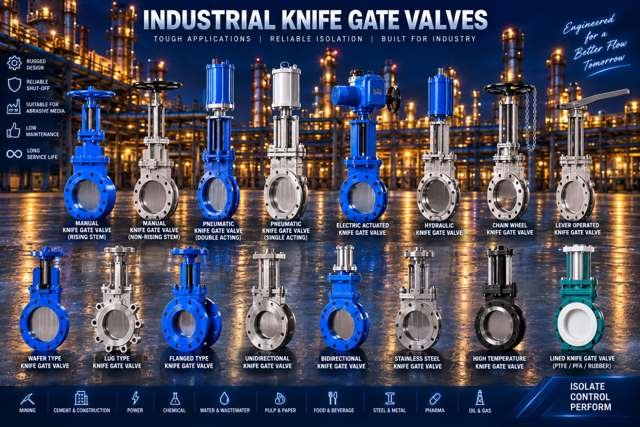
| Valve Types | Manual, Pneumatic, Hydraulic, Electric, Wafer, Lug, Flanged, Unidirectional, Bidirectional, Through-Conduit, Slurry |
| Valve Design | Linear Motion, Sharp-Edged Gate / Blade |
| Size | DN / NPS, as required |
| Pressure Rating | As applicable to valve design |
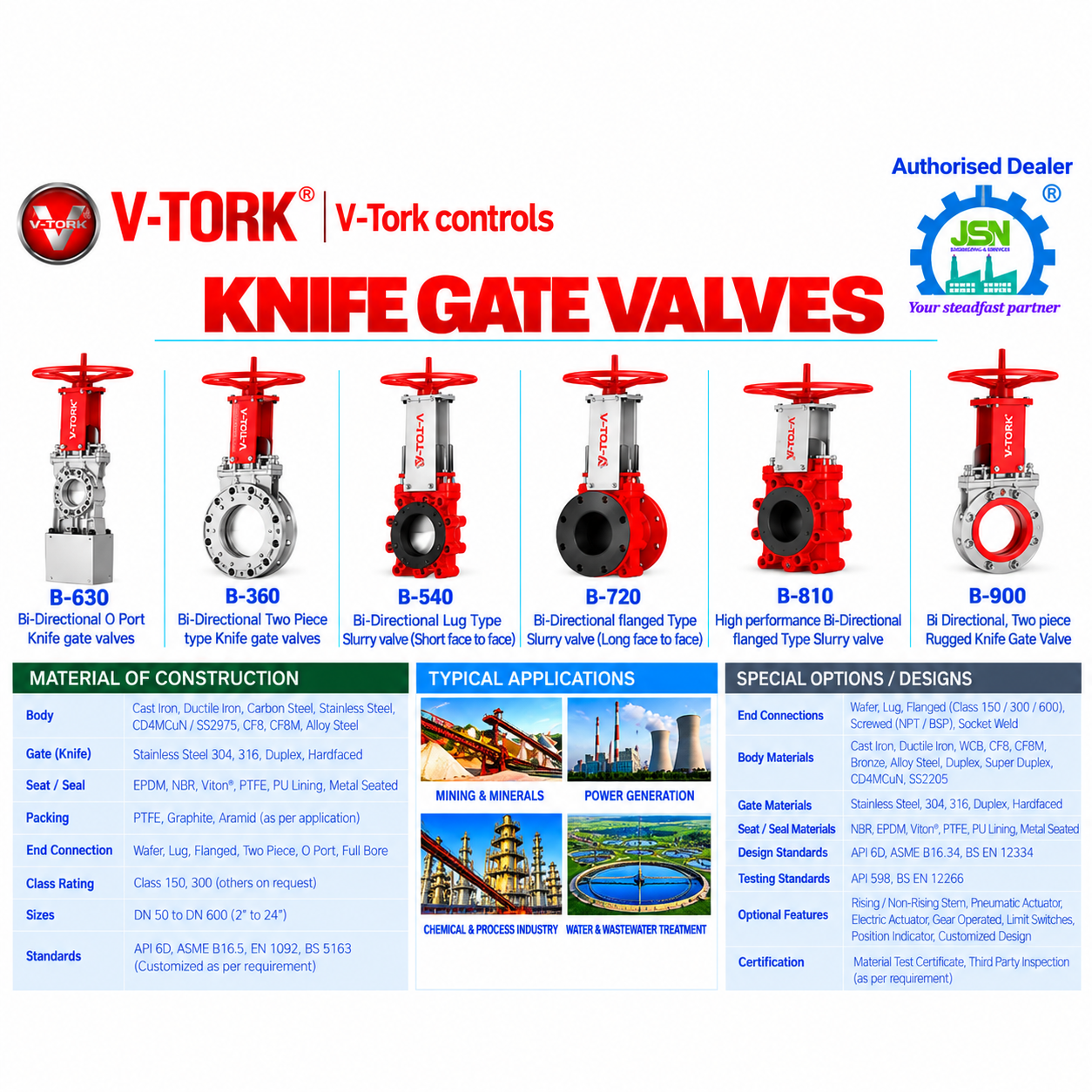
| Body Materials | Carbon Steel, Stainless Steel, Cast Iron, Ductile Iron, Alloy Steel |
| Gate Materials | Stainless Steel, Alloy Steel, Hardened Stainless Steel, Wear-Resistant Alloys |
| Seat Materials | Resilient, EPDM, NBR, PTFE, Metal, Hardened Seats |
| Packing | Selected according to fluid and temperature |
| End Connections | Flanged, Wafer, Lug-Type |
| Actuation | Handwheel, Chain Wheel, Gear, Pneumatic, Hydraulic, Electric |
| Flow Direction | Unidirectional / Bidirectional |
| Installation | Horizontal / Vertical, according to design |
| Applications | Slurry, Sludge, Pulp, Powders, Abrasive and Solids-Containing Media |
Product Information
Knife Gate Valves — Technical Overview & Selection Guide
Overview
Knife gate valves are linear-motion isolation valves designed primarily to start, stop, and isolate flow in piping systems handling slurries, powders, viscous fluids, sludge, pulp, and fluids containing suspended solids. The valve uses a sharp-edged gate or blade that moves through the process medium to provide effective isolation.
Knife gate valves are particularly suitable for abrasive, corrosive, fibrous, viscous, and solids-containing media where conventional valve designs may be susceptible to clogging or restricted flow. Depending on the design, knife gate valves may be used for unidirectional or bidirectional flow and can be supplied for manual or automated operation.
Key Features
-
Reliable on/off isolation
-
Sharp-edged gate designed to cut through solids and fibrous media
-
Suitable for abrasive and corrosive media
-
Excellent performance in slurry and solids-containing services
-
Full or reduced port designs available
-
Low-pressure-drop options available
-
Compact and lightweight construction
-
Suitable for viscous, fibrous, and solids-containing fluids
-
Available in unidirectional and bidirectional configurations
-
Suitable for horizontal and vertical installation, depending on design
-
Available for manual and automated operation
-
Flanged, wafer, and lug-type end connections available
-
Available in a wide range of sizes and pressure ratings according to design and manufacturer
Common Knife Gate Valve Types
-
Manual Knife Gate Valve
-
Pneumatic Knife Gate Valve
-
Hydraulic Knife Gate Valve
-
Electric Knife Gate Valve
-
Wafer-Type Knife Gate Valve
-
Lug-Type Knife Gate Valve
-
Flanged Knife Gate Valve
-
Unidirectional Knife Gate Valve
-
Bidirectional Knife Gate Valve
-
Through-Conduit Knife Gate Valve
-
Slurry Knife Gate Valve
-
Resilient-Seated Knife Gate Valve
-
Metal-Seated Knife Gate Valve
Technical Selection Parameters
Selection should consider:
| Parameter | Selection Consideration |
|---|---|
| Valve Type | Unidirectional / Bidirectional / Through-Conduit / Slurry |
| Size | DN / NPS |
| Pressure Rating | As applicable to valve design |
| Design Pressure | Project/design requirement |
| Design Temperature | Project/design requirement |
| Fluid | Liquid / Slurry / Sludge / Powder / Gas, as applicable |
| Flow Rate | Minimum / Normal / Maximum Flow |
| Solids Content | Particle size and concentration |
| Particle Size | Maximum particle size in process medium |
| Abrasiveness | Required gate and seat abrasion resistance |
| Corrosiveness | Required body, gate, and seat compatibility |
| Body Material | Carbon Steel / Stainless Steel / Cast Iron / Ductile Iron |
| Gate Material | Stainless Steel / Alloy Steel / Hardened Material |
| Seat Material | Resilient / Metal / Specialized Material |
| Packing | Selected according to fluid and temperature |
| Pressure Drop | Required flow capacity |
| Shut-Off Requirement | Required isolation and leakage performance |
| End Connection | Flanged / Wafer / Lug-Type, as applicable |
| Actuation | Manual / Pneumatic / Hydraulic / Electric |
| Installation | Horizontal / Vertical, according to design |
| Operating Frequency | Required cycle frequency |
| Vacuum Service | Required vacuum rating, where applicable |
Materials
Common knife gate valve body materials include:
-
Carbon Steel
-
Stainless Steel
-
Cast Iron
-
Ductile Iron
-
Alloy Steel, where applicable
The gate, stem, seat, packing, and other wetted or process-contact materials should be selected according to the fluid, pressure, temperature, abrasion, corrosion, erosion, and service requirements.
Common gate materials may include:
-
Stainless Steel
-
Alloy Steel
-
Hardened Stainless Steel
-
Special Wear-Resistant Alloys, where applicable
Gate & Seat Selection
The gate and seat configuration is a critical selection parameter for slurry, abrasive, corrosive, and solids-containing applications.
Selection may consider:
-
Abrasion Resistance
-
Corrosion Resistance
-
Temperature Resistance
-
Pressure Resistance
-
Solids Concentration
-
Particle Size
-
Fluid Compatibility
-
Flow Velocity
-
Required Service Life
-
Shut-Off Requirement
Common seat options may include:
-
Resilient Seats
-
EPDM Seats
-
NBR Seats
-
PTFE Seats
-
Metal Seats
-
Hardened Seats
-
Stellite® or equivalent hard-facing, where specified
For abrasive slurry applications, hardened or wear-resistant gate and seat materials may be preferred, while chemically aggressive services may require compatible stainless steel, alloy, polymer, or elastomeric materials.
Packing & Sealing
Knife gate valves may incorporate packing and sealing arrangements selected according to the process conditions.
Selection may consider:
-
Process Fluid
-
Operating Temperature
-
Operating Pressure
-
Corrosiveness
-
Abrasiveness
-
Emission Requirements
-
Required Leakage Performance
-
Operating Frequency
Specialized packing arrangements may be provided for demanding applications or where fugitive-emission requirements apply.
End Connections
Knife gate valves may be supplied with:
-
Flanged Ends
-
Wafer Connections
-
Lug-Type Connections
-
Other connections according to valve design
The end connection should match the piping system, pressure requirements, installation arrangement, and applicable project specifications.
Operation
Knife gate valves may be operated using:
-
Handwheel
-
Chain Wheel
-
Gear Operator
-
Pneumatic Actuator
-
Hydraulic Actuator
-
Electric Actuator
Pneumatic operation is commonly selected for automated slurry and process applications where frequent opening and closing or remote operation is required.
Quick Selection Guide
Fluid: Identify whether the service is liquid, slurry, sludge, powder, gas, pulp, or another process medium.
Solids Content: For slurry and solids-containing services, provide solids concentration, particle size, density, and characteristics of the suspended material.
Abrasion: Evaluate the abrasive nature of the process medium and select suitable gate, seat, and body materials.
Chemical Compatibility: Confirm compatibility of the body, gate, seat, packing, and other wetted materials with the process fluid.
Size: Specify DN/NPS based on piping size and required flow capacity.
Pressure: Provide operating and design pressure and confirm the applicable valve pressure rating.
Temperature: Specify minimum, normal, maximum operating temperature, and design temperature.
Valve Direction: Determine whether a unidirectional or bidirectional valve is required based on the piping arrangement and flow conditions.
Gate Material: Select gate material based on pressure, temperature, corrosion, erosion, abrasion, and solids characteristics.
Seat Material: Select resilient or metal seating according to temperature, abrasion, corrosion, fluid characteristics, and shut-off requirements.
Pressure Drop: Evaluate the required flow capacity and allowable system pressure loss.
Shut-Off: Define the required isolation and leakage performance.
Actuation: Specify manual, pneumatic, hydraulic, or electric operation.
Installation: Confirm horizontal or vertical installation requirements according to the selected valve design.
Vacuum Service: Where applicable, specify whether the valve will operate under vacuum and provide the required vacuum conditions.
Operating Frequency: Provide expected cycle frequency where the valve will be operated frequently.
Connection: Specify flanged, wafer, lug-type, or other applicable end connection.
Testing & Inspection
Depending on project specifications and applicable standards, knife gate valves may undergo:
-
Body pressure testing
-
Seat leakage testing
-
Functional and operational testing
-
Gate travel and stroke verification
-
Dimensional inspection
-
Seat and packing inspection
-
PMI (Positive Material Identification), where applicable
-
MTC verification
-
Visual and surface inspection
-
Actuator and accessory testing
-
NDE (Non-Destructive Examination), where applicable
Applications
Knife gate valves are commonly used in:
-
Mining
-
Mineral Processing
-
Slurry Handling
-
Cement Plants
-
Power Plants
-
Coal Handling Systems
-
Ash Handling Systems
-
Water Treatment
-
Wastewater Treatment
-
Sewage Treatment
-
Chemical Plants
-
Petrochemical Plants
-
Pulp & Paper
-
Dredging Systems
-
Sugar Industries
-
Food & Process Industries, where suitable materials are specified
-
Bulk Material Handling
-
Industrial Utilities
Engineering Inputs for RFQ
For technical enquiry and quotation, provide:
Valve Type • Size • Pressure Rating • Fluid • Flow Direction • Minimum/Normal/Maximum Flow • Solids Concentration • Particle Size • Fluid Density • Design Pressure • Operating & Design Temperature • Body Material • Gate Material • Seat Material • Packing • End Connection • Actuation • Installation Orientation • Abrasion/Corrosion Requirements • Vacuum Requirement, if applicable • Operating Frequency • Shut-Off Requirement • Testing & Inspection Requirements
Manufacturer Brands
1. ZOLOTO — Industrial Valves
Brand: ZOLOTO
Website: www.zolotovalves.com
2. MARCK — Industrial Valves
Brand: MARCK
Manufacturer: Hawa Engineers Ltd.
Website: www.marckvalves.com
3. LEHRY — Industrial Valves and Instrumentation
Brand: LEHRY
Manufacturer: Lehry Instrumentation & Valves Pvt. Ltd.
Website: www.lehryvalves.com
4. UFLOW — Automation and Process Control Valves
Brand: UFLOW
Manufacturer: Uflow Automation India
Website: www.uflowvalve.com
5. V-TORK CONTROLS — Industrial Flow Control Valves
Brand: V-TORK CONTROLS
Website: www.vtorkcontrols.com
6. PENNANT — Steam Traps and Pipeline Accessories
Brand: PENNANT
Manufacturer: Pennant Engineering Pvt. Ltd.
Website: www.pennantcorp.com